
「CoRL 2026」ResearchPortトップカンファレンス定点観測 vol.23

2026年11月15日 11時00分 公開

本記事3行要約:

● CoRL 2026の論文投稿数は2,094件・採択論文687件!
● 日本人著者を含む論文は31件!日本人著者は63名を確認!
● 論文出現キーワードで「humanoid」が3位、「world model」が7位に急上昇!


トップカンファレンス定点観測シリーズ vol.23、「CoRL(Conference on Robot Learning)」です。

ResearchPortでは2024年1月に「CoRL 2023」を取り上げ、ロボティクスと機械学習の融合領域において、今後さらに重要性が増していくカンファレンスとして紹介しました。当時のCoRL 2023は投稿498件、採択199件。

CoRL 2026 開催概要
▶ 開催期間: 9-12 Nov., 2026
▶ 開催都市: Austin, Texas, US
▶ 公式HP:  https://www.corl.org/home

前回記事では、2019年以降の投稿数がおおむね400~500件程度で推移していたことから、成長が楽しみな分野であるが「他のAI関連分野と比較すると爆発的に増えているような気配はない」と記載していました。

それから3年。

CoRL 2026の投稿数は2,094件となり、前回調査時の約4.2倍まで急増しておりました。
ロボティクス領域において、World Model、Embodied AI、Physical AIなどへの注目が急速に高まる中、CoRLの位置づけにも大きな変化が起きているように見えます。

■CoRLとは

CoRL(Conference on Robot Learning)は、機械学習とロボティクスを結びつけることを目標とした研究を対象とした国際会議です。
公式では、ロボットのためのMachine Learningの理論・実践を扱う「selective, single-track international conference」と位置づけられています。CoRL 2026では、Robot Foundation Models、自然言語によるRobot Instruction、Robot Safety / Alignment、Video Models / Latent World ModelsなどもCall for Papersの対象領域として明記されています。

2017年に始まった比較的新しい国際会議ですが、近年の機械学習技術の急速な進展とともに存在感を高めています。

■CoRL 2026総評

まずは全体の投稿・採択数について見ていきます。

CoRL 2026では、投稿数:2,094件・採択:687件・採択率:32.81%となりました。特に2025→2026での投稿数の伸びが大きく、わずか1年間で投稿数は約2.84倍、採択数も約2.61倍に増加しています。

Year #submissions #accepted papers #posters orals acceptance rate oral acceptance
rate
venue
2017 Mountain View, CA, USA
2018 Zurich, Switzerland
2019 398 110 27.64% Osaka, Japan
2020 475 165 34.74% Virtual
2021 400 153 127 26 38.25% 6.50% London, UK
2022 504 197 163 34 39.09% 6.75% Auckland, New Zealand
2023 498 199 166 33 39.96% 6.63% Atlanta, GA, USA
2024 693 264 234 30 38.10% 4.33% Munich, Germany
2025 737 263 221 42 35.69% 5.70% Seoul, South Korea
2026 2,094 687 666 21 32.81% 1.00% Austin, TX, USA

表1:CoRL 2017–2026年の論文投稿数および採択率

注)Oralについて
CoRL2026では、全687件の採択論文がPoster Sessionで発表され、その中から72件がSpotlight Talk、さらにOral Talkが設定されています。
今回の時系列集計では過年度との比較を行うため、Oral:21件 / non-Oral:666件(Poster-only 594件+Spotlight 72件)として整理しています。投稿2,094件に対してOral 21件ですので、Oral採択率は約1.0%となります。

※CoRLでは年度によって発表区分・形式が異なります。2026年はSpotlight 72件をnon-Oral側に含めて集計しているため、これまでのOral率との単純比較には留意が必要です。
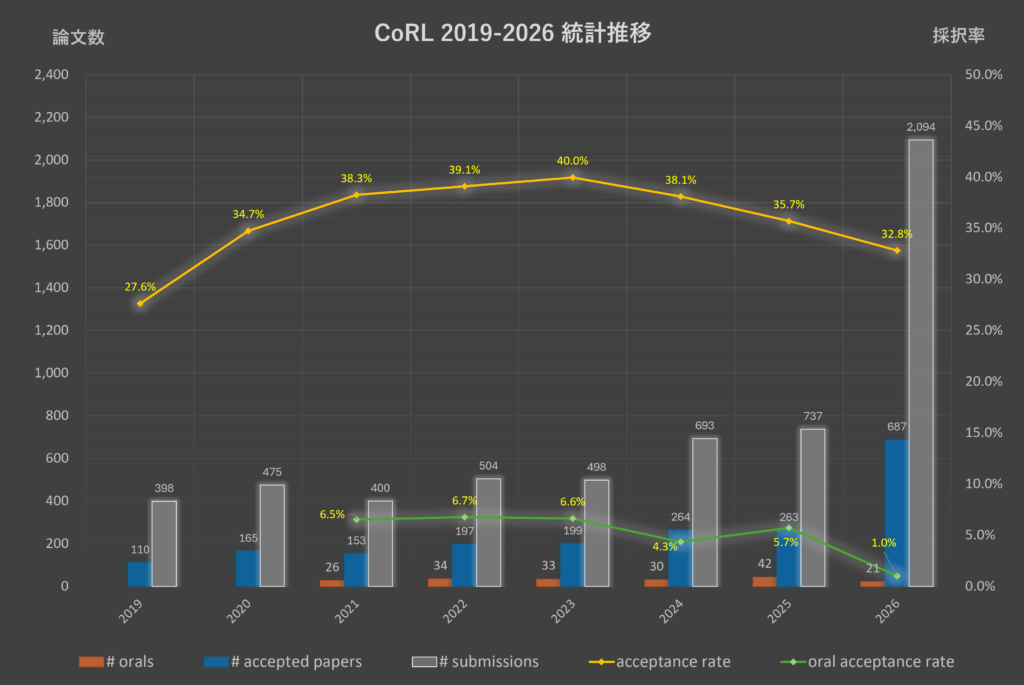
 

図1:CoRL統計推移

2019~2023年までは400~500件程度で推移していた投稿数が、2024年693件、2025年737件と増加し、2026年には一気に2,000件を超えました。

一方、採択率を見ると、2023年:40.0% → 2024年:38.1% → 2025年:35.7% → 2026年:32.8% と低下傾向にあります。投稿数が急増する中でも採択数を同じ比率で増加させているわけではなく、結果的に採択競争は徐々に厳しくなっていることが分かります。

また、スポンサー数も2023年の6社から2026年には76社まで増加しています。投稿数の急増だけでなく、企業・産業界からのCoRLへの関心も大きく高まっていることがうかがえます。

■日本人研究者の活躍

次に、日本人研究者の採択状況について見てみます。

今回の調査では、CoRL 2026の採択論文687件における全著者数はのべ5,202人で、1論文あたり平均7.57人でした。そのうち、日本人著者を含む論文は31件・日本人著者数はのべ77人でした。複数論文に採択されている著者の重複を除外すると63人となり、下記にある図2に示した通りになります。

開催年 採択論文数 全著者数
(のべ人数)
平均著者数 日本人著者数
(のべ人数)
日本人
著者比率
日本人著者を
含む論文数
日本人著者が
絡む論文比率
2017
2018
2019 110
2020 165
2021 153 758 4.95 2 0.3% 2 1.3%
2022 197 1,014 5.15 3 0.3% 3 1.5%
2023 199 1,111 5.58 13 1.2% 11 5.5%
2024 264 1,647 6.24 17 1.0% 12 4.5%
2025 263 1,751 6.66 13 0.7% 12 4.6%
2026 687 5,202 7.57 77 1.5% 31 4.5%

表2:CoRL投稿論文全体の著者数に占める日本人比率の推移

表2の通り、日本人著者を含む論文数の推移でも、前年の2025年 12件から2026年 31件と大幅に増加しております。前回調査のCoRL 2023のときには、日本人著者を含む採択論文は11本でしたので、この3年間での推移を見ると約2.8倍まで増えています。
一方で、全体の採択論文数が199件から687件へ約3.45倍となったのに対し、日本人著者を含む論文は11件から31件へ約2.82倍となっており、全体の伸びをやや下回っているという結果もありました。

CoRL 2026 日本人個人別採択件数 (63名)
著者 採択数
Masayoshi Tomizuka
5
Kei Ota
3
Masashi Hamaya
2
Tatsuya Matsushima
2
Kuniaki Saito
2
Koki Seno
2
Komei Sugiura
2
Yusuke Takagi
2
Kashu Yamazaki
2
Daichi Yashima
2
Kotaro Amaya
1
Yoshimitsu Aoki
1
Yukiyasu Domae
1
Daiki Fukunaga
1
Toshihiko Fukushima
1
Satoshi Funabashi
1
Kaneyoshi Hiratsuka
1
Noriaki Hirose
1
Kie Horiuchi
1
Hideyuki Ichiwara
1
Katsushi Ikeuchi
1
Kengo Ikeuchi
1
Hirokazu Ishida
1
Mariko Isogawa
1
Shun Iwase
1
Yushi Kaida
1
Naoaki Kanazawa
1
Asako Kanezaki
1
Kento Kawaharazuka
1
Mei Kinjo
1
masaki kitagawa
1
Ryosuke Kojima
1
Shuhei Kurita
1
Koshi Makihara
1
Ryusei Matsumoto
1
Yasuyuki Matsushita
1
Tomohiro Motoda
1
Kensuke Nakamura
1
Haruki Nishimura
1
Mai Nishimura
1
Hiroki Nishizawa
1
Yuki Noguchi
1
Takuya Okubo
1
Yoshihiro Okumatsu
1
Keisuke Okumura
1
Namiko Saito
1
Kirato Sakata
1
Yoko Sasaki
1
Takami Sato
1
Yoichi Sato
1
Yuto Shibata
1
Makoto Sugiura
1
Haruto Suzuki
1
Rui Suzuki
1
Masatoshi Tateno
1
Kento Tokura
1
Manabu Tsukada
1
Kota Tsuruhara
1
Yuki Wakayama
1
Marino Watanabe
1
Miyu Yamane
1
Osamu Yoshie
1
Kentaro Yoshioka
1

図2:CoRL 2026 日本人個人別採択件数 (63名)

個人別採択件数では、Masayoshi Tomizuka氏が5件で最多でした。
続いて、Kei Ota氏の3件、Masashi Hamaya氏・Tatsuya Matsushima氏・Kuniaki Saito氏・Koki Seno氏・Komei Sugiura氏・Yusuke Takagi氏・Kashu Yamazaki氏・Daichi Yashima氏がそれぞれ2件の採択という結果でした。

CoRL 2022-2026 累積採択数 
日本人著者ランキング
著者 採択数
Masayoshi Tomizuka
11
Noriaki Hirose
4
Kensuke Nakamura
4
Komei Sugiura
4
Haruki Nishimura
3
Kei Ota
3
Masashi Hamaya
2
Ayano Hiranaka
2
Shun Iwase
2
Tatsuya Matsushima
2
Takahiro Miki
2
Mitsuhiko Nakamoto
2
Keisuke Okumura
2
Kuniaki Saito
2
Koki Seno
2
Shinjiro Sueda
2
Yusuke Takagi
2
Jun Yamada
2
Miyu Yamane
2
Kashu Yamazaki
2
Daichi Yashima
2
Kotaro Amaya
1
Yoshimitsu Aoki
1
Yukiyasu Domae
1
Daiki Fukunaga
1
Toshihiko Fukushima
1
Satoshi Funabashi
1
Miyu Goko
1
Tatsuya Harada
1
Kaneyoshi Hiratsuka
1
Eisuke Hirota
1
Kie Horiuchi
1
Naoki Hosomi
1
Soshi Iba
1
Hideyuki Ichiwara
1
Yui Iioka
1
Takuya Ikeda
1
Shuhei Ikemoto
1
Katsushi Ikeuchi
1
Kengo Ikeuchi
1
Hirokazu Ishida
1
Mariko Isogawa
1
Yushi Kaida
1
Naoaki Kanazawa
1
Asako Kanezaki
1
Kei Katsumata
1
Kento Kawaharazuka
1
Mei Kinjo
1
masaki kitagawa
1
Ryosuke Kojima
1
Shuhei Kurita
1
Koshi Makihara
1
Ryusei Matsumoto
1
Yasuyuki Matsushita
1
Teruhisa Misu
1
Tomohiro Motoda
1
Mai Nishimura
1
Koichi Nishiwaki
1
Hiroki Nishizawa
1
Yuki Noguchi
1
Takeru Oba
1
Kentaro Oguchi
1
Ryoga Oishi
1
Takuya Okubo
1
Yoshihiro Okumatsu
1
Masahiro Ono
1
Seitaro Otsuki
1
Daichi Saito
1
Namiko Saito
1
Sho Sakaino
1
Kirato Sakata
1
Yoko Sasaki
1
Hiroya Sato
1
Takami Sato
1
Yoichi Sato
1
Yuto Shibata
1
Makoto Sugiura
1
Makoto Suminaka
1
Haruto Suzuki
1
Rui Suzuki
1
Masatoshi Tateno
1
Kento Tokura
1
Toshiaki Tsuji
1
Manabu Tsukada
1
Kota Tsuruhara
1
Yuki Wakayama
1
Marino Watanabe
1
Kentaro Yamada
1
Takuma Yoneda
1
Osamu Yoshie
1
Kentaro Yoshioka
1
Heiga Zen
1

図3:CoRL 2022-2026 累積採択数 日本人著者ランキング

2022年以降では、累積で92名の日本人著者を確認しました。特定の研究者・研究チームに限らず、CoRLで採択される日本人研究者の裾野が広がっていることがうかがえます。

■論文出現キーワードの推移

さらに、CoRLでも採択論文に出現するキーワード推移を見ていきます。早速、表3をご覧ください。

Year 2026 2025 2024 2023 2022 2021 2020 2019 2018 2017
#Papers 687 263 264 199 197 153 165 110 - -
Ranking Term Frequency Term Frequency Term Frequency Term Frequency Term Frequency Term Frequency Term Frequency Term Frequency Term Frequency Term Frequency
1 robot 25.04% robot 28.52% robot 22.73% robot 29.15% robot 21.32% robot 25.30% reinforcement learning 13.94% reinforcement learning 18.18% reinforcement learning 18.67% robot 26.53%
2 manipulat[***] 18.34% manipulat[***] 19.39% manipulat[***] 19.32% manipulat[***] 18.09% manipulat[***] 11.68% reinforcement learning 12.05% robot 12.73% robot 14.55% robot 17.33% simulat[***] 10.20%
3 humanoid 9.03% diffus[***] 8.75% reinforcement learning 7.20% reinforcement learning 9.55% reinforcement learning 10.15% manipulat[***] 10.84% predict 8.49% predict 7.27% navigat[***] 9.33% demonstrat[***] 10.20%
4 generat[***] 6.26% generaliz[***] 6.84% 3d 7.20% 3d 6.53% predict 7.11% imitat[***] 4.82% represent 8.49% manipulat[***] 6.36% manipulat[***] 9.33% generat[***] 6.12%
5 navigat[***] 5.10% adapt 6.46% navigat[***] 6.44% imitat[***] 5.03% estimat[***] 6.60% 3d 4.22% manipulat[***] 7.88% navigat[***] 6.36% estimat[***] 6.67% imitat[***] 6.12%
6 adapt 4.95% generat[***] 6.08% diffus[***] 6.06% generaliz[***] 5.03% demonstrat[***] 6.09% represent 3.61% navigat[***] 5.46% imitat[***] 5.46% simulat[***] 6.67% navigat[***] 6.12%
7 world model 4.51% estimat[***] 6.08% imitat[***] 6.06% offline 4.52% imitat[***] 5.58% predict 3.61% imitat[***] 4.85% demonstrat[***] 5.46% transfer 5.33% reinforcement learning 6.12%
8 diffus[***] 4.08% imitat[***] 4.94% autonomous 5.68% diffus[***] 4.02% autonomous 5.08% safe 3.61% autonomous 4.24% bayes 4.55% adapt 5.33% search 6.12%
9 generaliz[***] 3.79% navigat[***] 4.94% generat[***] 5.68% represent 4.02% represent 5.08% demonstrat[***] 3.61% motion plann 3.64% dynamics 3.64% demonstrat[***] 5.33% recogni 4.08%
10 reinforcement learning 3.79% reinforcement learning 4.56% locomotion 4.92% language model 3.52% interact 4.57% offline 3.61% estimat[***] 3.64% detect 3.64% reward 5.33% active learning 4.08%
11 interact 3.79% 3d 3.80% represent 4.55% scalab 3.52% 3d 4.57% latent 3.61% interact 3.64% probabilistic 3.64% imitat[***] 5.33% adapt 4.08%
12 imitat[***] 3.64% humanoid 3.80% safe 4.17% simulat[***] 3.52% adapt 4.57% graph 3.01% dynamics 3.64% predictive control 3.64% dynamics 4.00% adversarial 4.08%
13 latent 3.64% demonstrat[***] 3.42% adapt 3.79% interact 3.52% simulat[***] 4.06% constrain 3.01% transfer 3.64% latent 2.73% localiz[***] 4.00% predict 4.08%
14 represent 3.49% video 3.42% predict 3.79% pretrain 3.52% navigat[***] 4.06% estimat[***] 3.01% demonstrat[***] 3.64% represent 2.73% efficien[***] 4.00% online 4.08%
15 simulat[***] 3.49% autonomous 3.42% generaliz[***] 3.41% generat[***] 3.52% transformer 4.06% tactile 2.41% hierarch 3.03% estimat[***] 2.73% bayes 4.00% autonomous 4.08%
16 embod 3.49% represent 3.04% transfer 3.41% predict 3.02% generaliz[***] 3.55% autonomous 2.41% locomotion 3.03% constrain 2.73% benchmark 4.00% interact 4.08%
17 demonstrat[***] 3.35% embod 3.04% foundation model 3.41% navigat[***] 3.02% dynamics 3.55% detect 2.41% 3d 3.03% feedback 2.73% predict 4.00% transfer 4.08%
18 video 3.35% simulat[***] 3.04% efficien[***] 3.03% autonomous 3.02% transfer 3.55% generat[***] 2.41% adapt 3.03% policy gradient 2.73% embod 2.67% real world 4.08%
19 3d 3.20% predict 3.04% simulat[***] 3.03% graph 2.51% efficien[***] 3.55% navigat[***] 2.41% detect 3.03% attent 1.82% curios 2.67% bayes 4.08%
20 efficien[***] 2.91% safe 3.04% policy learning 3.03% heterogeneous 2.51% detect 3.55% reward 2.41% simulat[***] 3.03% generat[***] 1.82% feature 2.67% benchmark 2.04%
21 benchmark 2.77% constrain 3.04% detect 3.03% demonstrat[***] 2.51% offline 3.05% spars 2.41% unsupervised 2.42% multimodal 1.82% ground 2.67% dataset 2.04%
22 align 2.48% tactile 2.66% transformer 2.65% dynamics 2.51% reward 2.54% interact 2.41% policy learning 2.42% hierarch 1.82% 3d 2.67% object recogni 2.04%
23 tactile 2.48% latent 2.66% embod 2.65% efficien[***] 2.51% safe 2.54% depth 2.41% reward 2.42% locomotion 1.82% spars 2.67% ensembl 2.04%
24 agent 2.48% efficien[***] 2.66% humanoid 2.65% safe 2.51% point cloud 2.54% evaluat[***] 1.81% adversarial 2.42% adapt 1.82% condition 2.67% residual 2.04%
25 memor[***] 2.48% locomotion 2.66% demonstrat[***] 2.27% online 2.51% interpret[***] 2.54% task plann 1.81% localiz[***] 2.42% tactile 1.82% vehicle 2.67% segment 2.04%
26 evaluat[***] 2.48% pose estimat[***] 2.28% reason 2.27% transfer 2.51% pose estimat[***] 2.54% point cloud 1.81% latent 2.42% rl 1.82% lidar 2.67% semantic segmentation 2.04%
27 scalab 2.48% reason 2.28% spars 2.27% detect 2.51% generat[***] 2.54% motion plann 1.81% safe 2.42% identifi 1.82% generaliz[***] 2.67% incremental learning 2.04%
28 locomotion 2.33% reward 2.28% interact 2.27% reward 2.01% graph 2.03% dynamics 1.81% efficien[***] 1.82% system identif 1.82% descript 2.67% locomotion 2.04%
29 safe 2.33% interact 2.28% constrain 2.27% feature 2.01% embod 2.03% multimodal 1.81% lidar 1.82% regulariz[***] 1.82% policy optimiz 2.67% efficien[***] 2.04%
30 dynamics 2.18% motion plann 2.28% online 1.89% adapt 2.01% adversarial 2.03% manifold 1.81% condition 1.82% fusion 1.82% safe 2.67% expert 2.04%
31 policy learning 2.18% multimodal 1.90% splat 1.89% distill 2.01% locomotion 2.03% structur 1.81% generat[***] 1.82% safe 1.82% hierarch 2.67% tuning 2.04%
32 prior 2.04% benchmark 1.90% offline 1.89% transformer 2.01% attent 2.03% adversarial 1.81% contrastive 1.82% residual 1.82% search 2.67% descript 2.04%
33 online 2.04% world model 1.90% llm 1.89% vehicle 2.01% prior 2.03% prior 1.21% segment 1.82% optimal control 1.82% kernel 2.67% ground 2.04%
34 pretrain 2.04% policy learning 1.90% feature 1.89% search 2.01% tactile 2.03% articulat[***] 1.21% multimodal 1.82% evaluat[***] 1.82% answer 1.33% fluid 2.04%
35 predict 1.89% track 1.52% graph 1.89% estimat[***] 2.01% video 1.52% feedback 1.21% stochastic 1.82% depth 1.82% question answer 1.33% reconstruct 2.04%
36 transfer 1.89% synthe 1.52% instruction 1.89% collaborat[***] 2.01% policy learning 1.52% probabilistic 1.21% spatiotemporal 1.21% context 1.82% recogni 1.33% 3d 2.04%
37 rl 1.75% rl 1.52% multimodal 1.89% motion plann 2.01% world model 1.52% workflow 1.21% reason 1.21% adversarial 1.82% agent 1.33% generaliz[***] 2.04%
38 constrain 1.75% language model 1.52% rl 1.52% bayes 2.01% bayes 1.52% reconstruct 1.21% decentraliz 1.21% policy optimiz 1.82% transformation 1.33% motion plann 2.04%
39 ground 1.75% articulat[***] 1.14% language model 1.52% multimodal 2.01% depth 1.52% decentraliz 1.21% prior 1.21% decentraliz 1.82% represent 1.33% predictive control 2.04%
40 autonomous 1.75% recogni 1.14% gaussian splat 1.52% locomotion 2.01% fusion 1.52% sound 1.21% representation learning 1.21% graph 1.82% correct 1.33% haptic 2.04%
41 synthe 1.60% evaluat[***] 1.14% tactile 1.52% attent 2.01% descript 1.52% preference 1.21% point cloud 1.21% stochastic 1.82% detect 1.33% material 2.04%
42 composition 1.60% assembly 1.14% hierarch 1.52% ground 1.51% segment 1.52% locomotion 1.21% video 1.21% policy learning 1.82% object detec 1.33% intrinsic 2.04%
43 multimodal 1.60% point cloud 1.14% point cloud 1.52% adversarial 1.51% spars 1.52% synthe 1.21% agent 1.21% benchmark 1.82% gaussian process 1.33% signal 2.04%
44 condition 1.46% dynamics 1.14% synthe 1.52% track 1.51% track 1.52% search 1.21% offline 1.21% simulat[***] 1.82% depth 1.33% stochastic 2.04%
45 asynchron 1.31% prior 1.14% dynamics 1.52% synthe 1.51% online 1.52% vehicle 1.21% attent 1.21% efficien[***] 0.91% constrain 1.33% hidden markov model 2.04%
46 match 1.16% context 1.14% estimat[***] 1.52% align 1.51% latent 1.52% ground 1.21% benchmark 1.21% se(3) 0.91% weather 1.33% linear 2.04%
47 reason 1.16% dataset 1.14% object detec 1.52% discover 1.51% deform 1.52% localiz[***] 1.21% deform 1.21% verif 0.91% gan 1.33% markov 2.04%
48 feedback 1.16% disentangl 1.14% prior 1.14% context 1.51% evaluat[***] 1.02% annotat 1.21% embed 1.21% collaborat[***] 0.91% synthe 1.33% manipulat[***] 2.04%
49 preference 1.16% foundation model 1.14% descript 1.14% preference 1.51% match 1.02% expert 1.21% match 1.21% perceptual 0.91% pose estimat[***] 1.33% multimodal 2.04%
50 track 1.02% pretrain 1.14% video 1.14% embod 1.51% probabilistic 1.02% policy optimiz 1.21% object detec 1.21% manifold 0.91% deep neural network 1.33% sensor 2.04%
51 reward 1.02% agent 1.14% ground 1.14% object detec 1.51% synthe 1.02% transfer 1.21% expert 1.21% gaussian process 0.91% fluid 1.33% align 2.04%
52 discover 1.02% online 1.14% articulat[***] 1.14% tactile 1.51% nerf 1.02% disentangl 0.60% correct 1.21% mpc 0.91% rl 1.33% transfer learning 2.04%
53 residual 1.02% hierarch 1.14% condition 1.14% latent 1.01% scalab 1.02% geometry 0.60% tactile 1.21% correct 0.91% interven 1.33% depth 2.04%
54 estimat[***] 1.02% search 1.14% motion plann 1.14% contrastive 1.01% pretrain 1.02% track 0.60% predictive control 1.21% markov 0.91% compress 1.33% hierarch 2.04%
55 reliabl[***] 1.02% in the wild 1.14% reward 1.14% bootstrap 1.01% representation learning 1.02% gaussian process 0.60% calibrat[***] 1.21% autonomous 0.91% linear 1.33% estimat[***] 2.04%
56 hierarch 1.02% scalab 1.14% real world 1.14% render 1.01% sensor 1.02% physics 0.60% generaliz[***] 1.21% transfer 0.91% certification 1.33% slam 2.04%
57 transformer 0.87% discover 1.14% pretrain 1.14% stochastic 1.01% 6d pose 1.02% behavioral cloning 0.60% constrain 1.21% tuning 0.91% attent 1.33% discover 2.04%
58 counterfactual 0.87% label 1.14% evaluat[***] 1.14% foundation model 1.01% semantic segmentation 1.02% object detec 0.60% ground 1.21% compress 0.91% disentangl 1.33% policy gradient 2.04%
59 distill 0.87% retriev 0.76% feedback 1.14% calibrat[***] 1.01% multimodal 1.02% condition 0.60% optimal control 1.21% ground 0.91% feedback 1.33% video 2.04%
60 graph 0.87% decentraliz 0.76% bayes 1.14% pose estimat[***] 1.01% object detec 1.02% interven 0.60% depth 1.21% condition 0.91% material 1.33% hilbert 2.04%
61 collaborat[***] 0.87% calibrat[***] 0.76% collaborat[***] 0.76% equivariant 1.01% collaborat[***] 1.02% curios 0.60% search 0.61% interact 0.91% deterministic 1.33% dynamics 2.04%
62 reconstruct 0.87% pomdp 0.76% fusion 0.76% match 1.01% camera 1.02% regulariz[***] 0.60% fusion 0.61% video 0.91% phase 1.33% curriculum 2.04%
63 detect 0.87% localiz[***] 0.76% curriculum 0.76% rl 1.01% residual 1.02% contrastive 0.60% context 0.61% enhance 0.91% bernoulli 1.33% detect 2.04%
64 interven 0.87% distill 0.76% retriev 0.76% representation learning 1.01% predictive control 1.02% match 0.60% mdp 0.61% gan 0.91% scalab 1.33%
65 spars 0.87% condition 0.76% reconstruct 0.76% hierarch 1.01% reason 1.02% recogni 0.60% deep neural network 0.61% ensembl 0.91% domain randomization 1.33%
66 heterogeneous 0.87% preference 0.76% discover 0.76% point cloud 1.01% vehicle 1.02% relocaliz[***] 0.60% modulat 0.61% prior 0.91% randomiz 1.33%
67 motion plann 0.87% video generat[***] 0.76% representation learning 0.76% segment 1.01% tuning 0.51% simulat[***] 0.60% sam 0.61% curriculum 0.91% deform 1.33%
68 feature 0.73% graph 0.76% in the wild 0.76% condition 1.01% optimal transport 0.51% dataset 0.60% generative model 0.61% disentangl 0.91% motion plann 1.33%
69 sensor 0.73% real world 0.76% correct 0.76% depth 1.01% regulariz[***] 0.51% benchmark 0.60% scalab 0.61% expla[***] 0.91% collaborat[***] 1.33%
70 articulat[***] 0.73% verif 0.76% attent 0.76% game 1.01% posterior 0.51% scene reconstruction 0.60% rl 0.61% lidar 0.91% skill learning 1.33%
71 flow match 0.73% align 0.76% segment 0.76% spars 0.50% benchmark 0.51% data augment 0.60% probabilistic 0.61% object detec 0.91% context 1.33%
72 offline 0.73% interven 0.76% unsupervised 0.76% task plann 0.50% embed 0.51% lifelong 0.60% dataset 0.61% point cloud 0.91% kinematic 1.33%
73 recover 0.73% horizon 0.76% agent 0.76% encod 0.50% symbol 0.51% classifi 0.60% in the wild 0.61% 3d 0.91% interact 1.33%
74 expert 0.73% unsupervised 0.76% skill learning 0.76% assembly 0.50% ground 0.51% distill 0.60% recover 0.61% regress 0.91% generat[***] 1.33%
75 edit 0.73% answer 0.76% benchmark 0.76% embed 0.50% memor[***] 0.51% video 0.60% feature 0.61% nonparametric 0.91% modulat 1.33%
76 curriculum 0.73% question answer 0.76% align 0.76% group 0.50% topolog 0.51% identifi 0.60% instance segmentation 0.61% behavioral cloning 0.91% nonparametric 1.33%
77 geometry 0.73% contrastive 0.76% contrastive 0.76% real world 0.50% expla[***] 0.51% render 0.60% rgbd 0.61% pose estimat[***] 0.91% sensor 1.33%
78 spatiotemporal 0.58% data augment 0.76% sensor 0.76% world model 0.50% mining 0.51% lidar 0.60% feedback 0.61% domain randomization 0.91% interpret[***] 1.33%
79 token 0.58% splat 0.76% disentangl 0.50% lidar 0.51% instruction 0.60% kalman 0.61% randomiz 0.91% latent 1.33%
80 localiz[***] 0.58% gaussian splat 0.76% interpret[***] 0.50% 3d reconstruction 0.51% policy gradient 0.60% graph 0.61% reward 0.91% camera 1.33%
81 group 0.58% detect 0.76% gaussian process 0.50% reconstruct 0.51% efficien[***] 0.60% sound 0.61% replay 0.91% event camera 1.33%
82 foundation model 0.58% ood 0.76% kernel 0.50% render 0.51% bayes 0.60% asynchron 0.61% parametric 0.91%
83 representation learning 0.58% weakly supervised 0.67% asynchron 0.50% hierarch 0.51% label 0.60% pose estimat[***] 0.61% minimiz 0.91%
84 deform 0.58% nerf 0.67% feedback 0.50% structur 0.51% correct 0.60% render 0.61% curios 0.91%
85 retarget 0.58% boost 0.67% agent 0.50% style transfer 0.51% group 0.60% simultaneous localization and mapping 0.61% horizon 0.91%
86 calibrat[***] 0.58% knowledge distillat 0.67% 3d reconstruction 0.50% causal 0.51% align 0.60% real world 0.61% generaliz[***] 0.91%
87 classifi 0.85% geometry 0.67% reconstruct 0.50% spatiotemporal 0.51% minimiz 0.60% incremental learning 0.61% kinematic 0.91%
88 decod 0.81% calibrat[***] 0.67% vision and language 0.50% group 0.51% mdp 0.60% assembly 0.61% agent 0.91%
89 safe 0.81% continual learning 0.67% sound 0.50% policy optimiz 0.51% statistic 0.60% regress 0.61% asynchron 0.91%
90 llm 0.81% caption 0.67% policy optimiz 0.50% decentraliz 0.51% generaliz[***] 0.60% anomaly detection 0.61% online 0.91%
91 encod 0.78% foundation model 0.59% manifold 0.50% task plann 0.51% kalman 0.60% synthe 0.61% instance segmentation 0.91%
92 expert 0.78% annotat 0.59% articulat[***] 0.50% annotat 0.51% acoustic 0.60% se(3) 0.61% segment 0.91%
93 constrain 0.78% image generat[***] 0.59% geometry 0.50% dataset 0.51% ensembl 0.60% 3d reconstruction 0.61% sensor 0.91%
94 calibrat[***] 0.78% tuning 0.59% skill learning 0.50% domain adaptation 0.51% adapt 0.60% reconstruct 0.61% kernel 0.91%
95 point cloud 0.78% regulariz[***] 0.59% active learning 0.50% state space model 0.51% consistent 0.60% preference 0.61%
96 verif 0.74% group 0.59% submodular 0.50% augmented reality 0.51% anomaly detection 0.60% horizon 0.61%
97 label 0.74% lidar 0.55% regulariz[***] 0.50% visualiz 0.51% extract 0.60% actor critic 0.61%
98 translat 0.74% scalab 0.55% localiz[***] 0.50% deep neural network 0.51% collaborat[***] 0.60% relocaliz[***] 0.61%
99 collaborat[***] 0.71% answer 0.55% 6d pose 0.50% certification 0.51% heterogeneous 0.60% identifi 0.61%
100 federat[***] 0.64% image segment 0.55% retriev 0.50% equivariant 0.51% hierarch 0.60% rollout 0.61%
101 discover 0.60% medic 0.55% residual 0.50% reliabl[***] 0.51% calibrat[***] 0.60% pomdp 0.61%
102 lidar 0.60% correct 0.55% dataset 0.50% expert 0.51% camera 0.60% instruction 0.61%
103 unsupervised 0.60% image classifi 0.55% signal 0.50% interven 0.51% enhance 0.60% bayes 0.61%
104 topolog 0.60% descript 0.50% sensor 0.50% recogni 0.51% nerf 0.60% spik 0.61%
105 document 0.60% question answer 0.50% lifelong 0.50% calibrat[***] 0.51% mixture of expert 0.60% transformer 0.61%
106 quantiz 0.57% spatiotemporal 0.50% panoptic segmentation 0.50% perceptual 0.51% spatiotemporal 0.60% spars 0.61%
107 interpret[***] 0.57% expla[***] 0.50% tuning 0.50% instruction 0.51% stochastic 0.60% topolog 0.61%
108 tuning 0.57% reliabl[***] 0.50% composition 0.51% in the wild 0.60% signal 0.61%
109 semantic segmentation 0.57% curios 0.50% language model 0.51% descript 0.60% interpret[***] 0.61%
110 reliabl[***] 0.57% optimal control 0.50% context 0.51% domain randomization 0.60% linear 0.61%
111 contrastive 0.53% ode 0.50% generative model 0.51% posterior 0.60% manifold 0.61%
112 animat 0.53% fusion 0.50% verif 0.51% randomiz 0.60% structur 0.61%
113 structur 0.50% preference 0.51% rl 0.60% correlat 0.61%
114 topolog 0.50% rl 0.51% embod 0.60% heterogeneous 0.61%
115 composition 0.50% replay 0.51% online 0.60% phase 0.61%
116 constrain 0.50% lifelong 0.51% translat 0.60% sensor 0.61%
117 replay 0.50% correct 0.51% replay 0.60%
118 label 0.50% motion plann 0.51% equivariant 0.60%
119 lidar 0.50% encod 0.51% nonlinear 0.60%
120 correct 0.50% contrastive 0.51% recommend 0.60%
121 expla[***] 0.50% retriev 0.51% sensor 0.60%
122 evaluat[***] 0.50% object tracking 0.51%
123 importance sampling 0.50%
124 instruction 0.50%

表3:論文出現キーワード推移(2017-2026年)

2026年の上位キーワードを見ると、以下のような順でした。

● robot(25.0%)
● manipulat***(18.3%)
● humanoid(9.03%)
● generat***(6.26%)
● navigat***(5.10%)
● adapt(4.95%)
● world model(4.51%)

*「manipulat***」などの“ *** ”は、manipulation など、同じ語幹を持つ派生語をまとめた表記です。

robotとmanipulat***は、2022年以降変わらず上位1・2に位置しているキーワードです。
2026年に大きく順位を伸ばしたのが「humanoid」です。humanoidは2024年の2.7% [24位]、2025年の3.8% [12位]から、2026年には9.0% [3位]まで上昇しました。出現割合は前年から約2.4倍となっています。同様に「world model」も、2025年の1.9% [33位]から2026年には4.5% [7位]まで急上昇しています。

さらに、2026年は「embod***」が3.5% [16位]、「align」が2.5% [22位]、「agent」が2.5% [24位]となるなど、実世界を認識し自律的に行動するロボティクス技術に関連するキーワードが見られるようになりました。この傾向は、2026年に大きな注目を集めているPhysical AI/Embodied AIの潮流とも重なります。Physical AIというキーワードそのものよりも、humanoid、world model、embodiment、agent、interaction、imitationなど、Physical AIを構成する複数の研究テーマが同時に存在感を高めているようです。

■ 大規模モデルの技術を実世界AIへどうつなげるか

長期的な推移を見ると、2018~2020年には「reinforcement learning」が3年連続で1位でしたが、その後は徐々に低下し、2026年には3.8%で10位となりました。それに対して、「manipulation」は、2019年の6.4%から2026年には18.3%まで増加し、近年は継続して上位に位置しています。これはCoRLで扱われる研究が、特定の学習アルゴリズムそのものから、ロボットが実世界で何を認識し、どのように学習し、どのように行動するかという、より包括的なシステムへ広がっていることを表していると考えられます。

生成AIやFoundation Modelで急速に発展した大規模モデルの技術を、Robotの身体性や実世界における認識・推論・行動へどのようにつなげていくかという方向性が表れています。

今後も、CoRLがPhysical AI/Embodied AI研究の中心的なカンファレンスの一つになりつつあることがうかがえます。

■まとめ

以上のように、重要指標からCoRL 2026を考察してまいりました。

前回調査時から、CoRLの規模も研究潮流も大きく変化していることが見えました。投稿数は498件 → 2,094件、採択論文数でも199件 → 687件と大幅に増加し、CoRLの急成長に日本の研究コミュニティも追随しています。

前回の記事では、CoRLを「これから伸びるであろう成長著しい会議」と紹介しましたが、予想以上のスピードで規模は拡大しておりました。AIの研究対象がデジタル空間から実世界へと広がり、Embodied AIやPhysical AIへの注目が高まる中で、ロボティクスと機械学習の融合をテーマとしてきたCoRLの重要性はさらに増し、今後より大きな発展が期待されます。

データ解析・公開にあたっては細心の注意を払っておりますが、万が一、間違いなどございましたら遠慮なく弊社までご連絡ください。

 
編集:ResearchPort事業部

■Contact

本記事に関する質問や、ご意見・ご要望などがございましたらResearchPortまでお問い合わせください。
https://research-p.com/contactform/

関連記事
メンバーシップ登録

Membership Registration

博士課程在籍中の方 ポスドクの方 大学教員の方 企業研究者/技術者

ResearchPortでは、研究者・技術者の研究活動とキャリアを個別にサポートしています。
ご興味のある方は、ResearchPortメンバーシップにご登録ください。